


Learn how you can add user-centered design to your product development process to create products and services that address your audience’s pain points.
How the user-centered design process works
An example of great user-centered design
Incorporating user-centered design into your product development strategy
When it comes to creating a new product or service offering, where do you start? It’s essential to have user-centered design at the heart of your approach.
User-centered design is a concept that developers use to create new products or services, putting customers and their specific needs, goals, and feedback at the forefront of new and iterative ideas. User-centered designers know that they are not necessarily creating a product or service that they would use, but rather a product that addresses their customers’ pain points. The goal is for the product or service to solve a specific problem.
Let’s dive into the core principles of user-centered design and learn how you can incorporate these concepts into your own product development process.
How the user-centered design process works
The user-centered design process looks like this: Research → Concept → Design → Develop → Test, then back to Research. But it isn't always so linear. Throughout the process, you might go back to the last step to make changes.
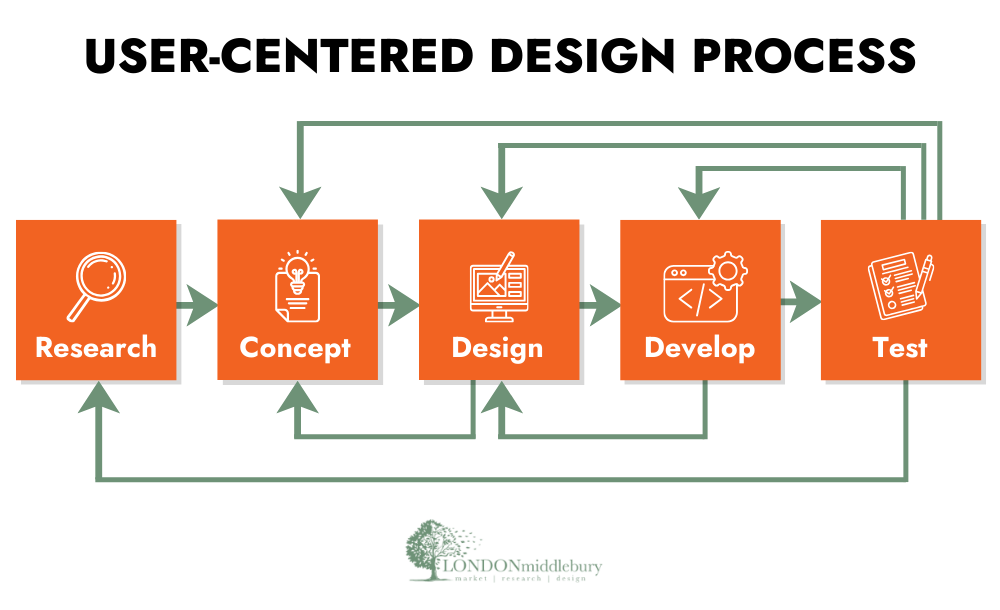
Say you have a set of products that work really well with a specific audience, so you want to create more that will appeal to them. You don’t have to start from scratch. Instead, start with research. Determining who makes up your audience is a crucial first step. By conducting interviews and surveys, you can get to know what types of products your customers are interested in. From there, you can move on to concepts and prototypes, then to design and development. Finally, you can test the products with focus groups, and their feedback will send you back to the beginning of the cycle to perform more research and create an even better version of your product.
By understanding your audience from the beginning, the entire process will be smoother, helping you upgrade your product and service offerings to ensure they actually solve a problem.
An example of great user-centered design
Spotify is the global leader for music streaming platforms, with more than 713 million users worldwide. But it wasn’t always this way.
While many folks loved Spotify from the beginning, there were a few important changes the platform made along the way to keep users coming back for more. In the early 2010s, the team’s research shows that listeners wanted to discover new music but felt overwhelmed by choice. It was this finding that inspired the drop of “Discover Weekly” in 2015, a playlist that comes out every Monday showing users tailored recommendations for new music.
It was a concept that hadn’t really been seen before on music streaming platforms, and users loved the introduction of it. More than 10 years later, “Discover Weekly” averages 2.3 billion streams per week, with a user satisfaction rate of 88%, according to internal surveys. If Spotify hadn’t listened to its customers, this hugely popular feature may have never existed.
Since then, the streaming platform implemented other features, like Daylists and Spotify Wrapped, to take some of the thought out of what artists to listen to and encourage users to listen more, giving them exactly what they desire.
Incorporating user-centered design into your product development strategy
Ready to take a user-centered design approach? Here are a few things you should do to make the process smooth:
Create user personas and journey maps
Understand how an example audience member goes through the buyer’s journey to purchase your product. If you find any hiccups or detours along the way, it may be time for a change.
Perform qualitative and quantitative user research
Ask customers to complete surveys once they’ve made a purchase to learn more about their behaviors. Pay attention to customer reviews, comments, and customer service traffic. Set up focus groups to hear anecdotally from your customers about problems your products could help solve. Work to understand your audience’s goals and pain points.
Build, test, and iterate early and often
Create prototypes and mockups to ensure product functionality and usability, and see how real people interact with these example products.
Involve customers throughout the process
This tactic really grasps at the “user-centered” aspect of the design process. Launch beta programs to receive feedback, and find or create spaces where your customers feel comfortable sharing their opinions.
Measure success and continue to optimize
Track important metrics and continue asking your customers questions to ensure your approach works. Even when the product launches, the work isn’t over. Always be on the lookout for how you can find ways to change, enhance, or improve what you’re offering.
User-centered design isn’t just a buzzword; it’s a mindset shift that will transform how you build products based on how your audience interacts with them. Prioritize understanding your customers. Don’t make assumptions about what they need. Listen to their feedback, both negative and positive. Use everything you learn to drive the next design iteration. Follow this ongoing approach and you’ll create products and services that solve important problems.
Need a partner in your new approach? Reach out to us today.